
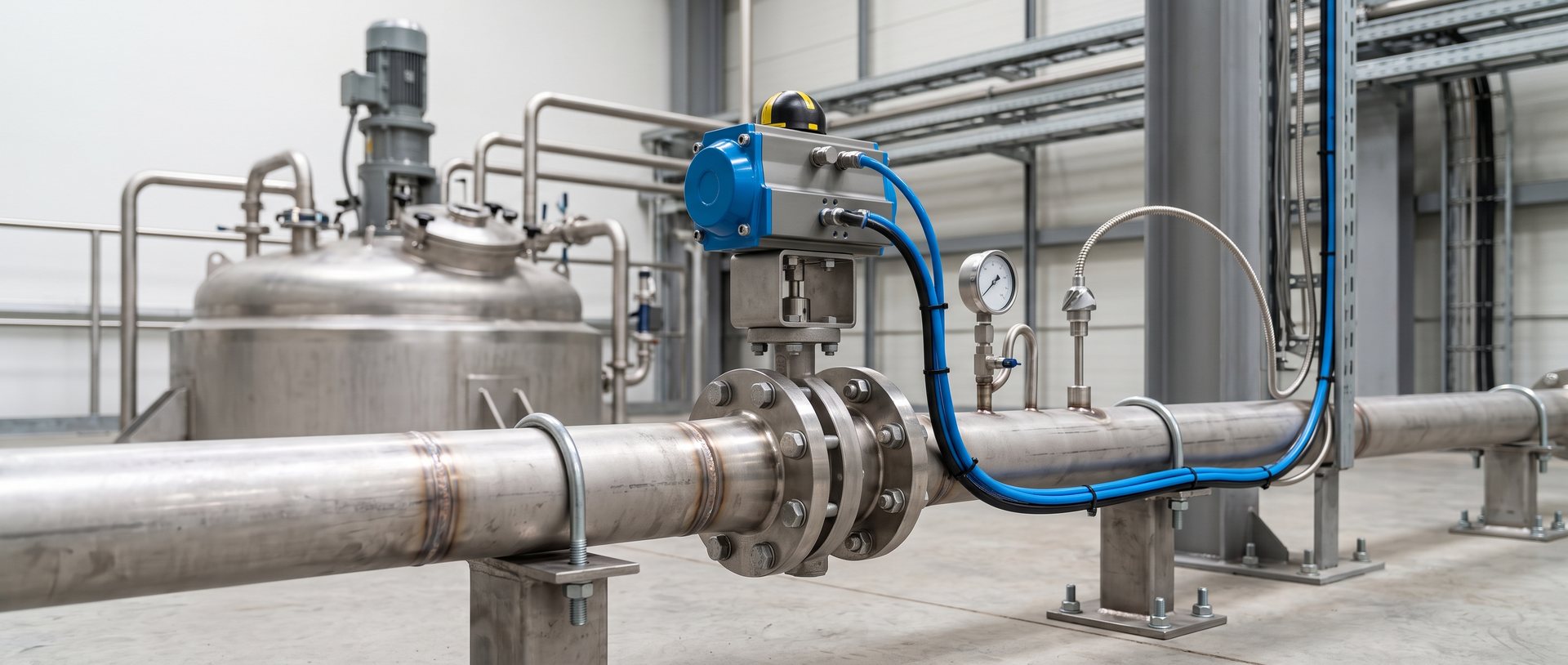
A controller can only act on what it is told. Sensors and instruments tell it what is happening in the plant. Valves and actuators carry out what it decides. You give us the specification and the application. We calculate and propose the devices, then wire them in and commission them with the control system.
WHAT WE SUPPLY
Three kinds of device, from sensing to action.
Detect
Know what is happening
Sensors tell the controller that a product has arrived, how far away it is, or how full a tank is.
Thru-beam and proximity sensors
Autonics
A thru-beam sensor detects anything that breaks a light beam between two units. A proximity sensor detects a part as it comes near, without touching it.
Laser distance sensors
Panasonic
Measure the distance to an object with a laser and send the reading to the controller.
Floatless level sensors
Omron
Electrodes in the tank detect when water or another conductive liquid reaches them, so there is no moving float. The controller can then start a pump or raise an alarm.
Measure and record
Hold it steady and keep a record
Controllers keep a process at the value you set. Recorders keep the history.
Temperature controllers
Autonics
Hold a heater, oven or process at the temperature you set, and show the reading.
Paperless recorders
Autonics
Record process values such as temperature on a screen and in memory, so there are no paper charts to replace.
Act
Carry out the command
Valves and actuators move things when the controller tells them to.
Pneumatic actuators
Camozzi
Use compressed air to push, pull or turn parts of a machine or a valve.
NAMUR solenoid valves
E-MC2
Solenoid valves with the NAMUR mounting, which fit directly onto pneumatic valve actuators so the controller can open and close process valves.
Process butterfly valves
Value Valves
VF-9A series double-offset butterfly valves, for shutting off and controlling the flow in pipework.
These are items we have supplied before. We propose the brand that fits the specification and the budget, and we also work with the brands a client already uses.
WIRELESS MONITORING
Where a cable cannot go.
Some things are hard to wire: moving equipment, remote sites, items that get carried around. Battery-powered wireless devices report from there instead.
Monitor
Bluetooth sensors
Teltonika
Small battery-powered sensors measure temperature, humidity and movement, and show whether a magnet is near, which can tell you if a door or lid is open. They send their readings by Bluetooth to a nearby receiver.
Technical
Measures temperature, humidity, movement and magnet status. Bluetooth Low Energy. Set up with the EYE app on a phone.
Track
Asset trackers
Teltonika
A small rechargeable tracker follows an asset and reports over the 4G mobile network. Its casing is rated IP68 for dust and water.
Technical
4G LTE Cat 1 connectivity. Rechargeable. IP68-rated casing.
TECHNICAL SCOPE
How the devices connect to the control system.
Inputs to the controller
Switching signals from sensors go to the PLC digital inputs. Analog signals, such as 4 to 20 mA or 0 to 10 V, go to the analog inputs.
Temperature control
Stand-alone temperature controllers hold the set value. Models with a communication port can also report to the PLC or SCADA.
Recording
Paperless recorders log process values with time stamps, for review and reports.
Valves and actuators
The PLC switches the solenoid valves through its outputs, and the valves drive the pneumatic actuators. Position feedback comes back through limit switches or proximity sensors.
Wireless monitoring
Teltonika Bluetooth sensors send their readings to a nearby receiver, and the 4G tracker reports over the mobile network. Both are for monitoring rather than control.
Integration
The devices are wired into the panel, set up and tested in the PLC programme, and shown on the HMI or SCADA screens, as part of our control system work.
Autonics, Panasonic, Omron, Camozzi, E-MC2, Value Valves and Teltonika are trademarks of their respective owners. The names are used here only to identify the equipment.
HOW WE WORK WITH IT
We engineer it, wire it in and commission it.
01
Engineer
You give us the specification and the application: what must be detected, measured or moved, the liquid or material, and the conditions on site. We calculate and propose the devices that fit the job and the budget.
02
Wire in
We wire the devices into the panel, connect them to the controller, and set up their signals in the programme and on the screens.
03
Commission
We test every device on site with the real process and commission it with you, so it arrives working.
Autonics, Panasonic, Omron, Camozzi, E-MC2, Value Valves and Teltonika are trademarks of their respective owners. The names are used here only to identify the equipment.
RELATED
Related services and products.
PLC and remote I/O
The controllers that command these drives
Industry control systems
Writting the programme and upgrading old controllers in stages.
PLC control panels and field works
Building the panel, wiring the devices and installing them on site.
Products
HMI and SCADA, Instrument and networking
Tell us what operators need to see.
Send us the machine or plant, how many screens or signals you expect if you know, and the system you run today.
We will calculate and propose the platform that suits it.